
OPINION · English source edition
Cameroon programmes show how broadcasting and accelerated learning can reconnect children with education. The next test is sustained return.
A lesson can travel through the air. A child's unanswered question cannot. That is the human challenge behind radio education: reaching a learner is the beginning of a relationship, and somebody still needs to notice what happens next.
UNICEF's 11 September account from Teke village in Kumba, Cameroon, describes radio education supported by trained facilitators. The programme covers foundational learning alongside life skills and psychosocial support. UNICEF reports that it operates through temporary learning spaces across the North-West and South-West regions. Its account presents children reconnecting with education after disruption; it does not establish their long-term progress.
A separate UNICEF report, also dated 11 September, describes CARED, an accelerated learning programme intended to help out-of-school children return to formal education. Its Kumba examples include a child displaced from Bamenda. These are accounts published by UNICEF, not interviews conducted by United Africa Today.
Together, the programmes invite a more careful definition of success. Broadcasting a lesson is a delivery measure. Attending a session is a participation measure. Learning, returning to school and remaining there are further outcomes. Each deserves its own evidence.
Our argument is that the most valuable part of a remote lesson may be the person who listens back. A facilitator can offer an opportunity for questions and reassurance. Programme design should make that role visible: time to explain again, materials learners can use and a way to recognise when somebody needs additional help.
That is particularly important when education has been interrupted. A child's age does not tell a teacher exactly which skills have been retained or missed. A return route should allow learning to be assessed without making a child feel that displacement or absence is a personal failure.
Radio also needs practical checks. Can the intended learners hear the broadcast? Is the schedule usable? Are the language and materials accessible? Can a child with a disability participate? These questions identify what a programme should examine. The source accounts do not provide a complete answer for every household, and we should not pretend that they do.
The next public update should therefore follow the connection beyond the learning space. How many participants enter formal education, and how many remain after a term? What support is available when a family moves again? What happens when a child cannot afford the practical requirements of returning? Results should be reported with clear denominators and without identifying vulnerable children.
None of this diminishes the immediate worth of learning. A programme can matter before every long-term outcome is known. It means respecting children enough to ask whether the opportunity continues after the photograph, the broadcast or the holiday course ends.
There is a role for communities as well as institutions. Adults can ask local education providers about verified return pathways and accessible learning support. They should avoid circulating children's names, displacement histories or locations in public appeals without appropriate protection.
In Kumba, the question worth following is whether a temporary bridge becomes a dependable route. A child deserves the chance to learn today and a credible place to continue tomorrow.
A useful public answer should identify the responsible institution, explain what evidence supports its position and give a date for the next update. Readers should be able to distinguish a promise from a completed action. When a question remains unresolved, the record should keep it visible rather than allowing a new headline to make it disappear.
Discussion: What should a programme track to show that children have reconnected with education, beyond the number of lessons broadcast?
Reporting limit: These are recent programme accounts from September, not evidence of a newly announced October initiative. Independent long-term retention and learning outcomes were not established in the sources reviewed.
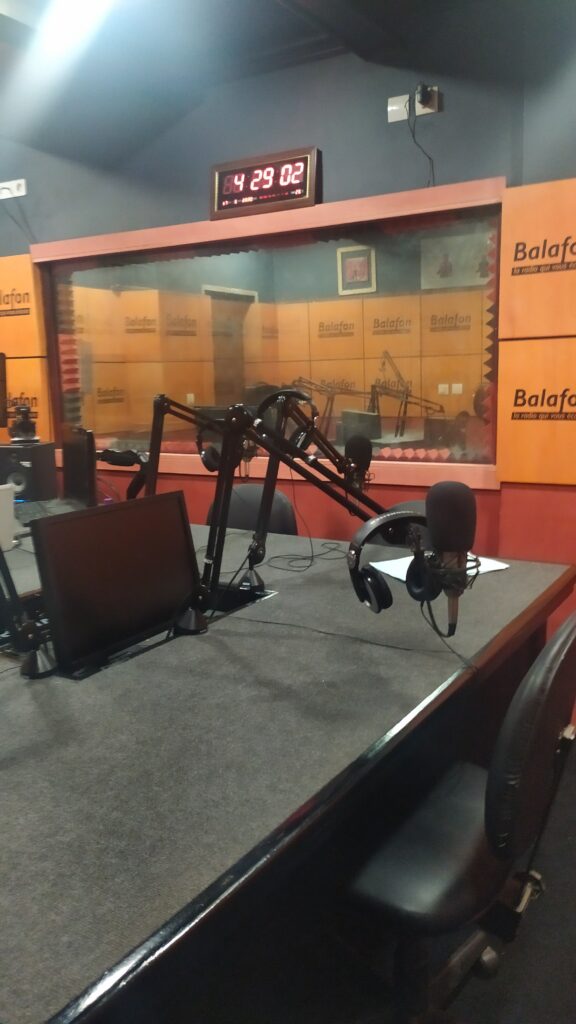
Archive photograph and credit
Original photograph · Rights record · CC BY-SA 4.0.
Caption: Radio Balafon's studio in Douala, Cameroon, photographed on 17 June 2020. Illustrative archive photograph of radio infrastructure; it is not the Kumba learning programme and does not establish Radio Balafon's participation in it. Photograph: Serieminou/Wikimedia Commons, CC BY-SA 4.0. Original image; disclose any later crop or other alteration.
Sources
UNICEF Cameroon, 11 September 2026 — radio education and learners reconnecting with education.
UNICEF Cameroon, 11 September 2026 — CARED and return to learning.


Join the conversation